
Reflections from the Tangata Mauri Māori Facilitation Wānanga
In early September 2026, I spent three days at Te Mauri Tau in Whāingaroa for Tangata Mauri – Māori Facilitation Exploration. I landed on the kaupapa almost by chance.
I had reached out to Katerina Kupenga from AraHina Strategic Planning Consultancy as part of some rangahau I’ve been doing for Uia Te Kura. I had followed and admired her mahi for some time, but we had never met. A couple of spaces had come up for the wānanga and she asked if I wanted to come along. It felt like the right kaupapa at the right time.
I had been thinking about doing some formal facilitation training. Facilitation has become a bigger part of my mahi over the years, but I have never really thought of myself as a “facilitator”. In my registration form I wrote that I felt like I was winging it most of the time.
Instead of a Western facilitation model, I knew I wanted something grounded in te ao Māori. The kaupapa of the wānanga being delivered primarily in te reo Māori was an added wero and an opportunity to keep stretching my reo after Takiura last year. So, I jumped at the opportunity.
Arriving at Te Mauri Tau
I arrived in Whāingaroa, for the first time, knowing no one. I was greeted by Whaea Helen Ritchie and Katerina — their reo and their smiles — and by the tūī, in the kōwhai tree in full bloom that stood as a pou within Te Mauri Tau. I pōhiritia mātou e ngā manu.
I remember feeling tau. Excited to learn what this kaupapa was about, but for once, not really nervous. As the rest of our rōpū arrived, Whaea Helen and Katerina talked us through the pōhiri process, the tikanga and how things would flow from there. It felt natural. There was learning in that arrival itself. We were given time and space to arrive.
Whakatau and whakawātea
One of the strongest practical lessons I took from the wānanga was:
Don’t skip whakatau and whakawātea!
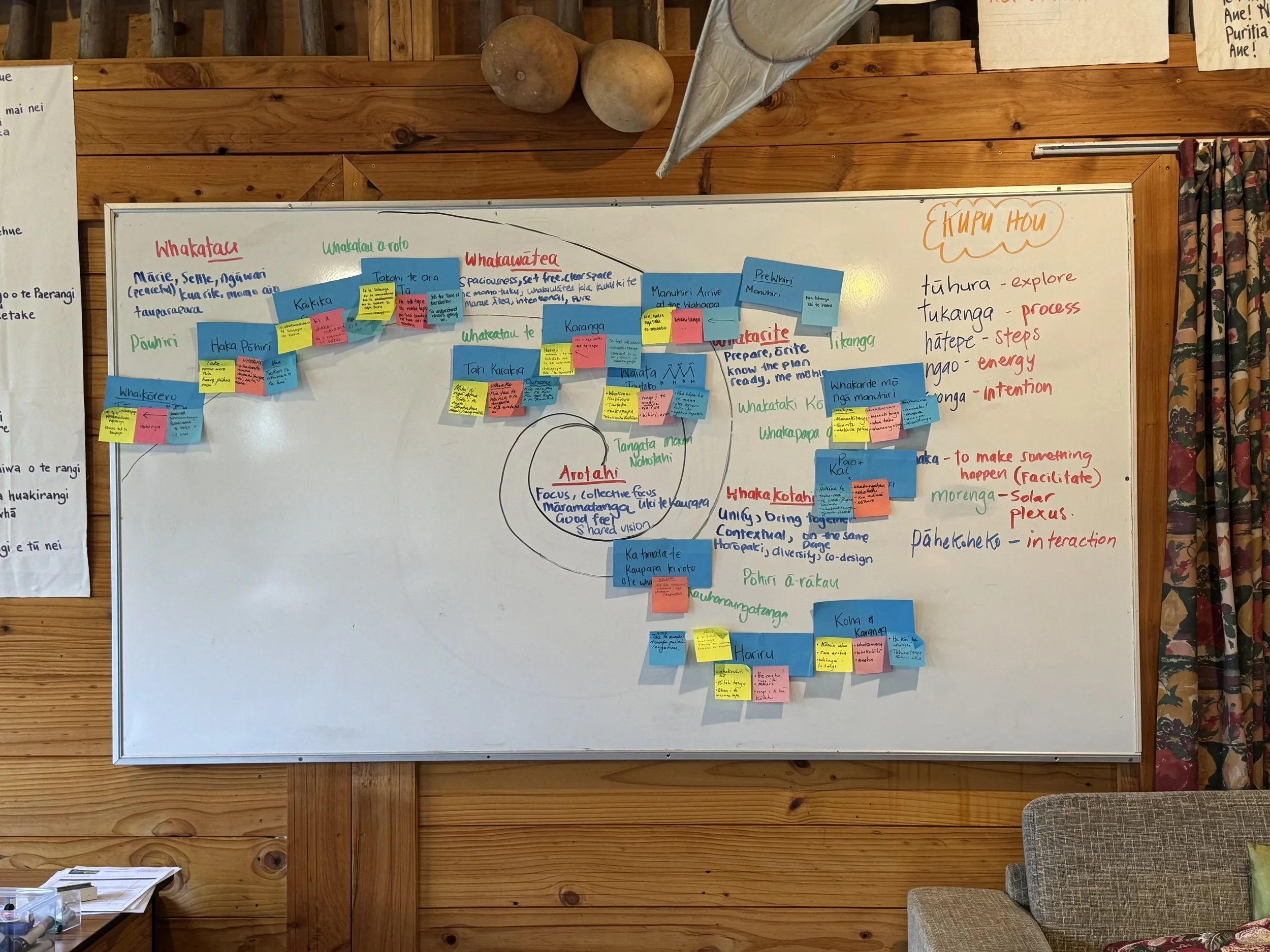
Through Tangata Mauri, we explored the processes within pōhiri to think about how we approach and move through facilitation. It made me realise how easily I can jump straight to whakarite. I live in whakarite. It is one of my strengths. Planning, organising, structuring, preparing, getting things ready, coming up with the plan.
And working in a Western-dominated world, it is easy to get pulled back into these ways of working because they are so normalised. We arrive, open the agenda, establish the objectives and get into the mahi. Through the wānanga, I was reminded of what can be lost when we do that.
We explored whakatau as making space for whanaungatanga, setting tikanga and connecting to the whakapapa of a kaupapa. Whakatau te tinana. Whakatau te mauri. Removing distractions and devices. Taking a moment to breathe. Giving people an opportunity to actually arrive and settle before asking them to contribute to the mahi.
We also explored whakawātea and the importance of acknowledging what has come before, as we move into what comes next. What needs to be acknowledged? What needs to be celebrated? What needs to be put to rest? What pathway needs to be cleared before we move forward?
Those questions are embedding into my practice. I came home and almost immediately found myself applying them to a new piece of mahi I was scoping. Rather than jumping straight into designing the next growth phase of the kaupapa, I started thinking: we need to capture, acknowledge and celebrate the whakapapa of this kaupapa first.
It also made me think about a long-term kaupapa I’m involved in that has gone through a name change. Did we do enough to whakawātea the previous name before stepping into the new one? I’m not sure. But I hadn’t asked myself that question before.
From holding space to Tangata Mauri
At the beginning of the wānanga, we were asked to write down what we thought facilitation was and put it into a kete until the end of our time together. I wrote something along the lines of:
Facilitation is holding space. It’s wānanga. It’s someone standing in front of the room. It’s someone guiding a group.
“Holding space” is language I’ve used for a long time. But over the three days, my understanding of what that actually means shifted.
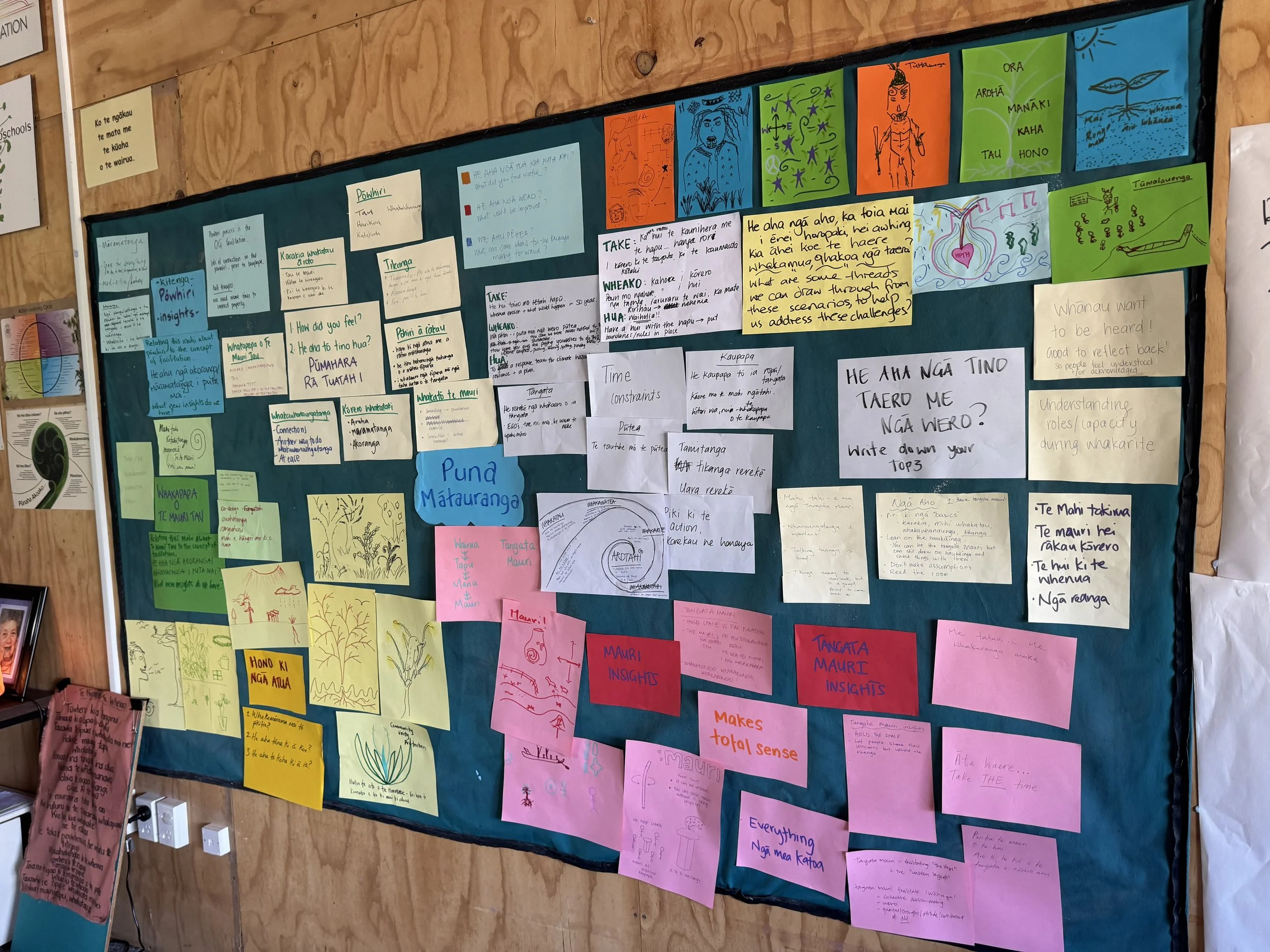
We explored different layers of mātauranga through the wānanga, including pōhiri, mauri and atua. Then Katerina shared kōrero from Dr Rangimarie Rose Pere’s Ako: Concepts & Learning in the Māori Tradition (page 29) about tangata mauri and the role of facilitators within whānau and hapū.
Rose Pere writes about tangata mauri in relation to collective planning and decision-making, participation, and facilitators recognising the qualities, strengths, attitudes and contributions of others. She describes the concept as dealing with “the essence of the organisation and political affairs of whanaungatanga.”
That was the point where the puzzle pieces came together for me. I could see why we had spent time exploring each of those different layers. They started to weave together into a picture that made sense. By the end of the wānanga, my understanding of Māori facilitation had shifted to:
Mā te Tangata Mauri e pupuri, e tiaki, e ārahi i te mauri o te kaupapa, o te hui, me ngā tāngata.
It changed how I thought about my role in a hui, wānanga or kaupapa. I realised that as a Tangata Mauri, I don’t need to have all the answers. I learnt to pay attention to what is happening with the mauri of the kaupapa, the hui and the people around the tēpu. I learnt Māori facilitation is about paying attention to the unseen. The things that are felt but aren’t necessarily being said. Those feelings, instincts and side thoughts I might otherwise brush away. I learnt that sometimes it’s important to find a way to bring what is unseen into the physical. I learnt that sometimes what I am sensing is a tohu for how or where we might move next.
Bringing the mauri of the kaupapa into the room
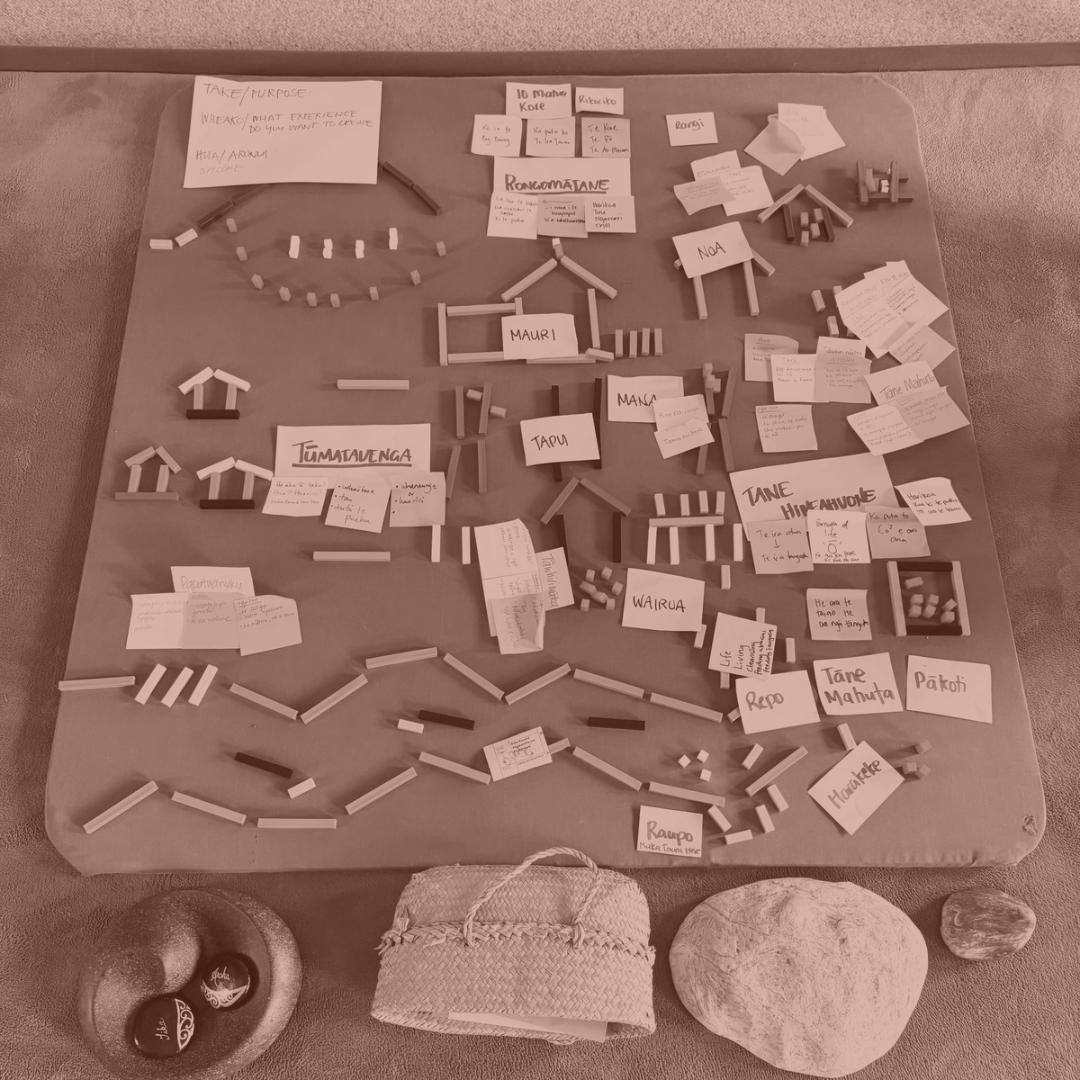
One of the whakaaro shared during the wānanga that stood out for me was about finding ways to bring the mauri of a kaupapa physically into the space. Katerina shared an example from her practice of bringing tipu rākau into a wānanga, representing mokopuna and future generations. Donna Barlow-Rolleston shared an example of bringing hue into her wānanga and connecting to the mātauranga and mauri of Hinepūtehue and what she and her taonga might bring to the hui. It made me ask: What is the mauri of the kaupapa I am holding? How might I bring that mauri into the room?
The taonga already in my kete
I came away from Te Mauri Tau feeling full of ideas, inspiration and confidence. Mauri full. Kete full. I was also reminded of what was already in my kete — woven from many experiences, learnings, roles, kaupapa and communities over the years. And I realised I haven’t always given myself permission to draw from it.
I think I have carried this belief that because I am not a mātanga in an area of mātauranga, perhaps it isn’t my place to share it or draw from it in my mahi. But I left Te Mauri Tau with a deeper sense of ownership of the mātauranga I do carry, and a deeper connection to atua and mātauranga in a way that felt accessible to me. I felt a stronger sense of responsibility.
I do carry taonga, mātauranga and experiences. I have a responsibility to use them, to share them, and to help others connect with, learn from and experience them too. I left feeling grounded and reminded that I have access to so much of what I need within te ao Māori. I just need to remember to tap in.
What happens when te ao Māori is the starting place? What happens when I ground into mātauranga, atua, pūrākau, tikanga, whakapapa and taiao and draw from those bodies of knowledge to guide the mahi? For me, this connects to the wider decolonisation and reindigenisation journey I am on. Because even when we are Māori practitioners working with Māori communities and kaupapa, many of us are still working within systems where Western ways of working are normalised.
Sometimes I think, that’s what the client wants. But Tangata Mauri made me question that too. Maybe part of my role — and part of Uia Te Kura’s role — is to support the people, organisations and kaupapa I work alongside to reindigenise their practice and ways of working too. I’m still figuring out what that looks like.
I reo Māori te reo
From the moment I stepped out of my waka and greeted the first fellow tauira, i reo Māori te reo. The kaupapa of the wānanga wasn’t to ako i te reo, but te reo was the language through which the kaupapa was delivered and flowed. It always takes my roro some time to switch over to te reo, and then for my roro to reconnect with my arero. But as the wānanga progressed, I felt more confident and at ease. Until we had to role-play i te reo Māori 😂. Acting and impromptu reo at the same time was definitely a wero. I ngana mātou!
It made me think more seriously about my ability to facilitate i te reo Māori in the future, and about being more confident and bold in bringing reo into the delivery of my mahi. I’m not a mātanga reo, but I have a solid foundation. Te reo Māori is a taonga I have worked hard to strengthen, and I have a responsibility to use it. It has left me thinking much more critically about what a reo strategy for Uia Te Kura might look like.
What I’m carrying forward
I went to Whāingaroa looking for facilitation training. I came home thinking differently about facilitation altogether. About my role within a hui, wānanga or kaupapa. About the seen and unseen, and the kete I already carry. About starting from te ao Māori and the responsibility I have to bring that forward through Uia Te Kura and the kaupapa and organisations I support.
At the end of our wānanga, we returned to that kete and reflected again on what facilitation meant to us. My commitment to myself as Tangata Mauri was:
Don’t skip whakatau and whakawātea!
Prioritise the mauri of the kaupapa and bring it into the room.
There is still plenty I am sitting with and making sense of. I think there will be for some time, I am looking forward to the next wānanga.
He mihi
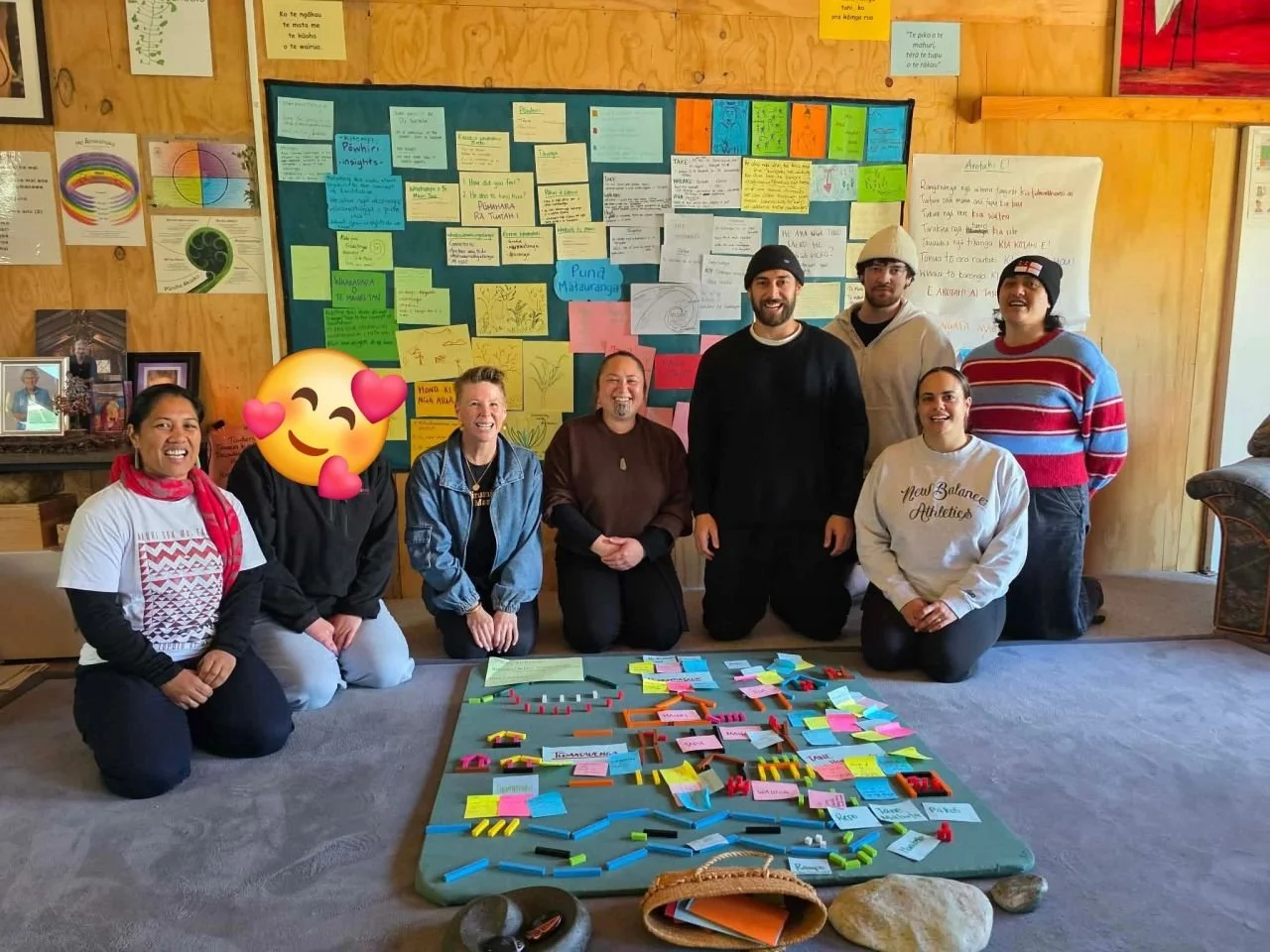
He mihi nui ki ngā Kaikawe — Katerina Kupenga, Hamuera Maika, Donna Barlow-Rolleston me Te Atawhai Kumar — for sharing your mātauranga, experiences and practice with us so generously.
Ki ngā Pou Tūara, Tuihana Bosch rāua ko Helen Ritchie, me Te Mauri Tau, tēnā koutou i ō koutou manaaki, for creating and holding such a special place for us to wānanga and learn.
Ā, ki ōku hoa Tangata Mauri — Wiripo Ritchie, Tumanako Ritchie, Savanna Kaingaroa Lauder koutou ko Makere Ripikoi — tēnā koutou for everything we shared, questioned, practised, laughed about and learned together.
Mauri tū, mauri ora!
Image credit (right): Katerina Kupenga
